3D Forming: Machines & Technology for Bending Plastics
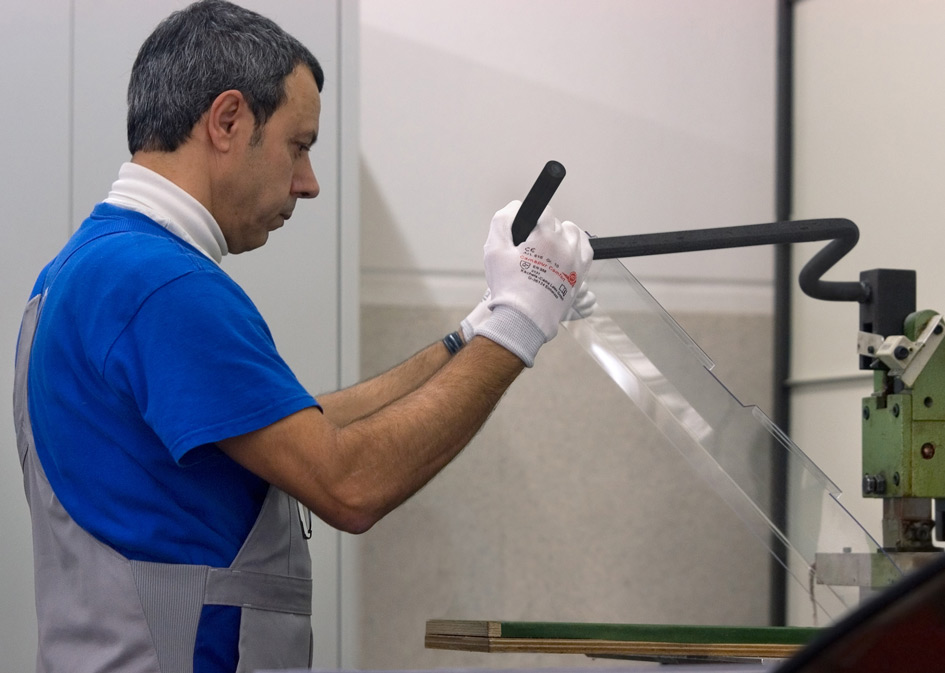
J. Schwarz uses a range of cold and heat forming machines for precision 3D forming of plastics. An electrically driven CNC press brake enables controlled cold bending of suitable plastics. Plastic bending machines with infrared and hot-wire technology are available for heat forming.
The machine is selected according to the material, thickness, desired shape and requirements of the finished component.
CNC Press Brake for Cold Forming
For cold forming, J. Schwarz operates an electrically driven CNC press brake with 80 tonnes of pressing force and a working width of 3,000 mm.
The machine enables controlled bending of suitable plastic sheets. A laser-controlled monitoring system ensures consistent bend angles, supporting precise and reproducible manufacturing.
Compared with hydraulic systems, the electrically driven press brake can reduce bending times by 30 per cent.
The machine combines a large working width with controlled angular accuracy and short processing times.
Plastic Bending Machines for Heat Forming
For heat bending, J. Schwarz uses plastic bending machines with a working width of up to 1,200 mm. The appropriate plastic bending machine is selected according to the material and desired shape. Plastic sheets up to 20 mm thick can be processed.
During heat forming, the material is selectively heated along the intended bend line. This makes thermoplastics pliable so they can be formed into the required geometry. Acrylic or Plexiglas® can also be heat-formed in this way to create a defined three-dimensional shape.
The material, thickness, desired radius and component shape determine how heating and bending are coordinated.
Infrared Technology with Four Heating Zones
For controlled heating of plastics, the bending machines feature infrared technology with four heating zones.
This allows heating to be tailored to each bending task. This is particularly relevant when working with different materials and thicknesses, as plastics have different properties and forming temperatures.
Infrared technology allows the material to be specifically prepared for the subsequent bending process.
Hot-Wire Technology for Tight Radii
Hot-wire technology provides another option. It is used when defined temperature zones and tight radii are required.
Heating is concentrated on the intended bending area. This allows the plastic to be heated along a defined line and then formed into the desired shape.
Hot-wire technology expands the capabilities of plastic bending machines, particularly for components with precisely defined bend lines and radii.
Blade Bending Machines for Plastic Films
J. Schwarz also uses blade bending machines for heat forming films. Here too, the material is heated along the intended bend line and then formed.
The process and machine used for a specific application depend on the properties of the plastic, its thickness and the desired geometry.
Embossing as Another 3D Forming Method
In addition to bending, embossing is another 3D forming method available at J. Schwarz. A suitable embossing tool creates a defined shape in the material.
This expands the possibilities for shaping plastic parts beyond simple bends.
Matching Machine and Material to the Shape
In 3D forming, the available machine alone does not determine the result. Material, thickness, bend radius, geometry and desired bend angle must all be considered together.
The CNC press brake can be used for cold forming suitable plastics. Where the material needs to be selectively heated before bending – for example, when heat forming acrylic or Plexiglas® – an appropriate plastic bending machine with suitable heating technology is available to meet the requirements.
This equipment allows J. Schwarz to tailor the process to each component.
3D Forming at J. Schwarz
Selecting the right technology for your plastic part starts with the requirements of the finished component. We assess the material, thickness, dimensions, radii and desired geometry and select the machine and process accordingly.
Our CNC press brake for cold forming and plastic bending machines with infrared, hot-wire and blade bending technology provide a range of options.
Your component’s requirements determine the technology we use.

Frequently Asked Questions About Plastic Bending Machines
What working width does the CNC press brake offer?
The electrically driven CNC press brake at J. Schwarz has a working width of 3,000 mm and a pressing force of 80 tonnes.
What material thicknesses can the plastic bending machines process?
The plastic bending machines are designed for material thicknesses up to 20 mm and have a working width of up to 1,200 mm.
How is the plastic heated for heat bending?
J. Schwarz uses technologies including infrared heating with four heating zones and hot-wire technology. The technology is selected according to the material and desired shape.
How are consistent bend angles achieved during cold forming?
The CNC press brake features a laser-controlled monitoring system that helps maintain consistent bend angles.
Which machine is suitable for my plastic part?
This depends on factors such as the plastic, material thickness, dimensions, desired bend radius and geometry. J. Schwarz matches the machine and forming process to the specific manufacturing task.